Introducting The Pool Theory, a young adult novel. From author Alexa Nazzaro's website the description reads:
If you asked Kye Penton what his greatest accomplishment is, he'd probably say surviving years of bullying with nothing but his only friend Anthony and movies like The Godfather to get by.
But at fifteen, things are finally looking up. By some miracle, Claudia in English likes him, and Julian is both his new friend and a super cool guy in general. It looks like Kye's days of being an outcast are ancient history - until Annie Cooper shows up: pregnant and claiming the baby is his.
A young adult contemporary novel that tackles teen pregnancy, bullying and social anxiety head-on, The Pool Theory is an honest depiction of what it means to live out the so-called best years of your life when all you want to do is disappear off the face of the earth.
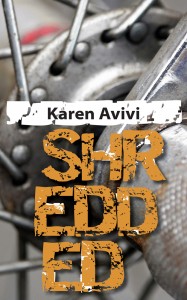
The description of Shredded from Karen Avivi's website reads:
A contemporary young adult novel
Drop into the world of rule-breaking, gravity-defying girls who shred riding freestyle BMX
“I would have preferred handlebars in the gut.
At least when that happened I definitely saw it coming.”
Shredded by Karen Avivi is more than a girls’ sports book or a BMX biking book. The motivating push-your-limits story takes on feminism, friendship, sexism, and sibling rivalry.
Josie Peters thinks she’ll do anything to ride in the Ultimate BMX freestyle event the summer before her senior year. To hit the qualifying events in the Midwest, Josie and her friends take off on a summer road trip where late-night parties, an intimidating mega ramp, and the lure of sponsorships spark friction between the girls. When Josie’s best chance for success depends on her relationship with flashy rider R.T. Torres, she has to decide what she’s trying to win and how much she’ll sacrifice.
Even readers unfamiliar with BMX or extreme sports will be caught up in the adrenaline rush of Josie’s tricks, wipeouts, and wins. Hints of romance provide extra conflict without overtaking the main plot. Ideal for fans of realistic young adult fiction, Shredded features a strong female lead character who goes after what she wants by taking action.
Both these authors will be at Chapters (6321 Transcanada Highway, Pointe-Claire, H9R 5A5) from noon until 4 p.m. on November 2nd to sign copies of their books. Drop by to see them if you can!
My friend, Linda Nguyen, has published her first short story! I met Linda through her and we'd often meet with other bloggers to share insight, experiences and even a trip to New York for the annual BEA convention. She would talk about writing and share some of her stories with her fellow bloggers. With this publication, Linda is now well on her way! The Blind Side is the title of Linda's first published story. Congratulations, Linda!
The second book in the Junction Chronicles, A Murder of Crows by David Rotenberg continues
the story of Decker Roberts, acting professor and discerner of truths.
Decker is a synaesthete – a person who has with the rare sensory ability
to perceive if someone is telling a truth. Though A Murder of Crows
does bring Decker’s story further, you can still read this book without
having read The Placebo Effect, the first novel in this series.
I
enjoyed this novel for its story line as well as the main character.
I’m a fan of Decker’s wit and his true-to-life persona. The author knows
his characters well and writes them with consistency. They are not all
good or all bad but a mixture of both. I know I’m reading a good book
when a likeable main character admits to an unlikable trait.
The
story has twists and turns and enough suspense that I wanted to keep
reading to find out what happens. In this second novel, there are more
explanations of the synesthete ability and what happens when someone is
using it - though it could be I just picked up more on the effects of
using this sensory ability in this book than I did in the first,
nevertheless, it rounds out the story and leaves the reader with the
impression that more will be revealed in the next novel.
A
Murder of Crows is a polished, well-written novel that explores what
happens when a person is born with a gift that can be used for both good
and evil. I like to think that if I had this special gift, I would use
it only for good, but the temptation to serve one’s heart desire must be
great. Decker faces this dilemma and more in this great series. I
highly recommend it for anyone who likes a mix of genres. Give it a try!
Tuesday Teasers is hosted by Should Be Reading.
The rules are as follows:
Grab your current read and let the book fall open to a random page.
Share two sentences from somewhere on that page and the title of the
book that you’re getting the teaser from. Please avoid spoilers! Read
the official Tuesday Teaser Rules.
My teaser is from The 100-Year-Old Man by Jonas Jonasson. From page 73:
While the company commander sat in his foldable military field chair and ruminated upon whether Allan's immediate future was employment or execution, one of the platoon leaders whispered in his ear that the young sergeant who so unfortunately had just been shot to bits had previously affirmed this strange Swede's abilities as a master in the field of explosives.
Tuesday Teasers is hosted by Should Be Reading.
The rules are as follows:
Grab your current read and let the book fall open to a random page.
Share two sentences from somewhere on that page and the title of the
book that you’re getting the teaser from. Please avoid spoilers! Read
the official Tuesday Teaser Rules.
I received Case Histories by Kate Atkinson from LibraryThing's Secret Santa event. The teaser is from page 83:
Her complaint, the reason she had originally engaged Jackson's services, was that someone was stealing her cats. Jackson couldn't work out whether cats really did go missing or whether she just thought they went missing.
Tuesday Teasers is hosted by Should Be Reading.
The rules are as follows:
Grab your current read and let the book fall open to a random page.
Share two sentences from somewhere on that page and the title of the
book that you’re getting the teaser from. Please avoid spoilers! Read
the official Tuesday Teaser Rules.
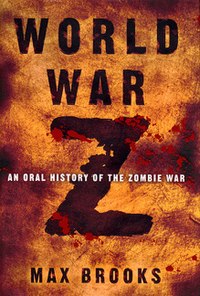
My teaser this week is from World War Z by Max Brooks. From page 118:
'I thought I heard something, a sound from the other bank...that sound, you know, when they are all together, when they are close, that...even over the shouts, the curses, the honking horns, the distant sniper fire, you know that sound.'
Posted by
Donna
at 4:53 PM
City of Dark Magic by Magnus Flyte was released yesterday to great reviews! I am really looking forward to reading this novel. The description of this book reads:
Prague: once a city of
alchemists, astronomers, heretics, and--it’s even been rumored--portals to
hell, and now the destination of every disaffected, beer-loving kid in a
backpack. But when musicologist Sarah Weston accepts an invitation to
spend the summer at Prague Castle cataloging Beethoven’s manuscripts for the
wealthy Lobkowicz family, she discovers a city filled not with ex-pats, but
with dark magic, where the fabric of time is thin and danger lies around every
corner.
Soon after Sarah arrives, strange
things begin to happen. Her predecessor may have been murdered, and Sarah
finds herself at the center of escalating and dangerous mysteries spanning
several centuries. Who is killing off the academics at the museum?
What secrets of time travel was a sixteenth-century alchemist hiding? Who
was Beethoven’s Immortal Beloved? What Communist-era intrigue is a powerful
American politician willing to kill to cover up?
In CITY OF DARK MAGIC, Prague
comes to life with cinematic scenes filled with excitement and intrigue. With
the turn of each page, you could find murder, paranormal time travel, a handsome
prince in search of the Golden Fleece or a 400-year-old dwarf who holds a
golden key that will unlock the city. Rollicking, sexy and wildly
imaginative, CITY OF DARK MAGIC could be called a rom-com paranormal
suspense novel—or it could simply be called one of the most entertaining novels
of the year, which will leave you anxiously awaiting the sequel.
My Mailbox Monday for this week features a book I received for review called A Murder of Crows by David Rotenberg. I read and reviewed the first book in this series and I'm really looking forward to enjoying this one too.
Since Decker Roberts’ last run in with the NSA, he’s been trying to remain off the radar, searching for his estranged son. His synaesthetic abilities, once a lucrative gift, are increasingly becoming a liability.
When a vicious attack wipes out the best and brightest of America’s young minds, devastating the country’s future, Decker is forced to step out of the shadows and help track down the killer. And as the hunt brings him in contact with other people of “his kind,” Decker begins to realize that there may be depths to his gifts that he had never even imagined.
Meanwhile, several parties are secretly tracking the progress of Decker’s son, Seth, trying to determine if he has the same unique gift as his father. Decker is determined to go to any lengths to find his son, but along the way he will have to face down enemies, both old and new, as well as struggle with whether his son even wants to be found.
David Rotenberg’s thrilling sequel to The Placebo Effect is full of suspense, and will challenge what you think you know about people who have special “gifts.” From rural Africa to downtown Toronto, the paths of Rotenberg’s colorful characters intertwine as they move towards a conclusion that none of them can see coming.
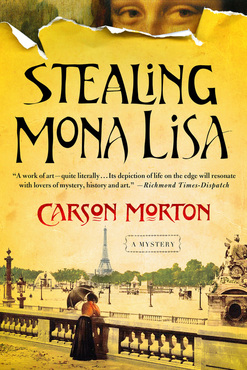
I picked this up at the library because I was attracted by the cover but I kept reading because of the story. In this charming novel by Carson Morton, it seems the bad guys are the good guys and the really bad guys are bad.
From the title, the plot centers around the theft of the Mona Lisa and the gang of thieves who concoct the plan to take it from the Louvre. This book has a lot going for it - humour, romance, intrigue and a style of story-telling that is slightly reminiscent of years past that blends nicely with the time setting - 1925. The place settings - mostly the US and France - are wonderful backdrops to the story line.
People who like the the Mary Russell series by Laurie R. King may like this book.
I purchased The Dewey Decimal System by Nathan Larson because I won the first book in this series through LibraryThing's ER program. The following is taken from the book's inner flap:
After a series of large-scale terrorist attacks and the total collapse of Wall Street, New York City is reduced to a shadow of its former self. As the city struggles to dig itself out of the wreckage, a nameless, obsessive compulsive veteran with a spotty memory, a love for literature, and a strong if complex moral code has taken up residence at the main branch of the New York Public Library on 42nd Street.
Dubbed "Dewey Decimal" for his desire to reorganize the library's stock, our protagonist (who will reappear in the next novel in this series) gets by as bagman and muscle for New York City's unscrupulous district attorney. Dewey takes no pleasure in this kind of civic dirty work; he'd be perfectly content alone amongst his books. But this is not in the cards, as the D.A. calls on Dewey for a seemingly straightforward union-busting job.
What unfolds throws Dewey into a bloody tangle of violence, shifting allegiances, and old vendettas, forcing him to face the darkness of his own past and the question of his buried identity. With its high body count and delightfully irreverent dialogue, the Dewey Decimal System pays respects to Chandler, Hammett, and Jim Thompson. Healthy amounts of black humor and speculative tendencies will appeal to fans of Charlie Huston, Nick Tosches, Duane Swierczynski, and Jonathan Lethem.








 Posts
Posts

